Guide to Dating Arthur P. Schmidt Publications

Or, “When did Arthur P. Schmidt print my sheet music?”
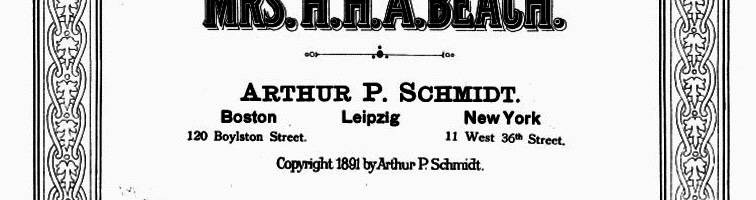
This is a guide that I created primarily for myself, but which anyone who has a few of Schmidt’s publications sitting on the bookshelf or tucked into the piano bench may find useful. The problem is that the copyright notice on the music displays the original year of publication even when the copy that you are looking at was printed years or sometimes decades later.

Continue reading “Guide to Dating Arthur P. Schmidt Publications”
Mr. Schmidt Goes to Washington

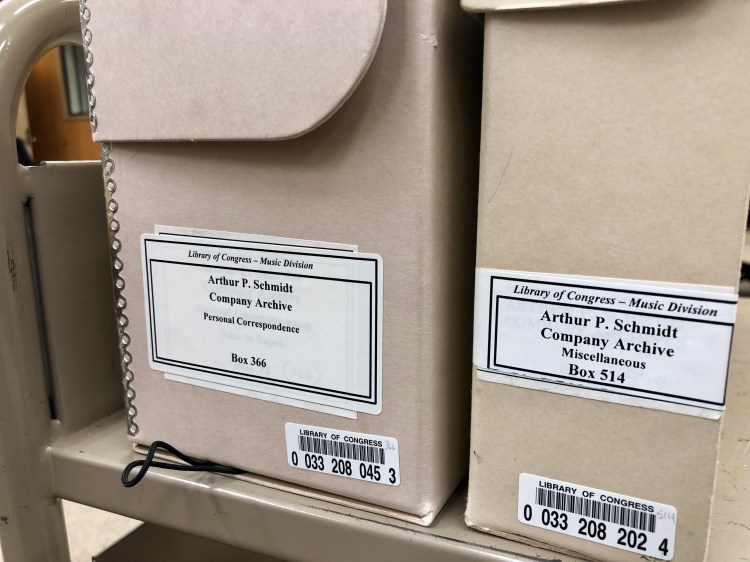
The Library of Congress holds an extensive collection of Arthur P. Schmidt documents

Having recently traveled down to Washington, D.C., to conduct some research at the Library of Congress, I found myself reflecting on my (thus far) limited yet always memorable experiences digging through our nation’s libraries and archives. An archive can often be rich in information yet also almost meaningless without a historian (like me—or you!) to figure out what is significant about it. That’s when the “stuff that happened” begins to turn into history, and that’s also why people tend to argue about history even when they agree with each other about the basic facts.

I had somehow managed to write an entire doctoral dissertation in music history without having needed to do any firsthand archival research. But as I later began to focus more and more on American music publisher Arthur P. Schmidt, I realized that I needed to see some important primary sources for myself.

Continue reading “Mr. Schmidt Goes to Washington”

Arthur P. Schmidt in the Digital Age

Detail from Henshaw Dana’s ”It Was a Knight of Aragon” (1878).

Determined to spend at least part of my summer “break” on work that was not so serious and/or urgent, I recently digitized a couple of first editions from American music publisher Arthur P. Schmidt for the International Music Score Library Project. While Schmidt’s catalogue was already well-represented, visitors to the library can now download complete scans of Henshaw Dana’s “It Was a Knight of Aragon” (1878), with lyrics by Thomas Bailey Aldrich, and Wilhelm Carl Ernst Seeboeck’s Impromptu-Nocturne Op.118, No.1 (1902) for solo piano. Both works have long been in the public domain, an essential prerequisite for inclusion in the library, and are moreover long out of print. My hope is that scholars and even performers will once again find value in the two pieces, for which full bibliographical information appears below.

Continue reading “Arthur P. Schmidt in the Digital Age”

Adventures in R

The path was humbling, the path was steep, the path was sometimes so obscure that I wasn’t sure I knew the way. But earlier this summer, my first scratch-built digital research project went live on the shinyapps.io hosting platform. Written almost entirely in the R markdown programming language, A Visual Guide to Some Nineteenth-Century Composers and Their Publishers takes a quantitative look at the economic relationships that helped nine ten prominent composers to get their music into print during the long nineteenth century. You can go behind the scenes and view the code for the entire project here on GitHub.

I came to R only after having concluded that none of the more user-friendly, prepackaged software options could offer precisely the combination of features and customizability that I had in mind for the project. Even with a series of handy R cheat sheets scattered around my desk, the process certainly took longer than the prepackaged route. But I’d like to think that much of the time spent importing the data, writing the scripts, and (inevitably) troubleshooting the resulting website will pay me back with interest as I embark on other R-based projects in the future. 

Continue reading “Adventures in R”

Is That You, Mr. Berlioz?

Portrait of Hector Berlioz by Pierre Petit, 1863

In my large lecture courses, I often introduce musical examples by displaying a portrait of the composer in question. For composers who lived up through the early nineteenth century, I show paintings. For the more recent composers, I show photographs.

The oldest of these photographs are (unavoidably) grainy, black-and-white affairs. They are an excellent means to illustrate the contemporaneous state of photographic technology, but less than ideal as a means to bring their subjects to life for the students.

Given the recent hubbub over the use of artificial intelligence (AI) to digitally upscale and then later colorize the famous Arrival of a Train at La Ciotat, filmed by the Lumière brothers in 1895, I thought I would see what AI could do for my old photos of famous composers.

Continue reading “Is That You, Mr. Berlioz?”

Music History Anthologies

The University at Buffalo is the first institution at which I’ve encountered the undergraduate music history survey being delivered across only two semesters. Brandeis University offers a sequence of five courses, as I recall, but with the requirement that students take just three of them. The music history faculty here at UB have recently been thinking about which printed anthology of scores works best as a course text for the survey, the challenge being that most publishers now seem to divide the sequence into three volumes instead of two.

While thinking about this question, I have found it difficult to avoid broader considerations of course content and teaching style. A complex topic! But if we begin by taking the question at face value, there remains at least one ready solution.

Continue reading “Music History Anthologies”

American Musicological Society, Boston 2019

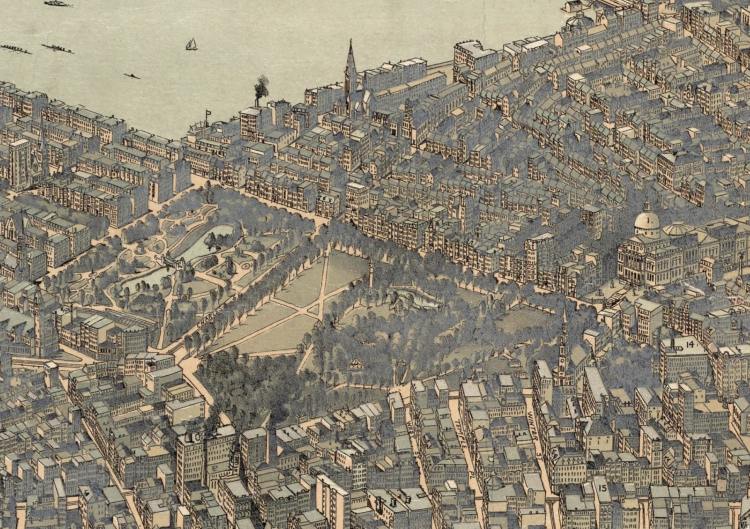
Historic map of Boston published by E. A. Downs (Boston, 1899).

I am very pleased to be presenting a paper entitled “Sounding the Interrogative: Cadential Attenuation as Syntactic Device in the Madrigals of Sigismondo d’India” on Friday, November 1, at the 85th annual meeting of the American Musicological Society. The session, to be chaired by my friend and colleague Joel Schwindt (Boston Conservatory), is entitled “Rhetorical Devices” and will also feature papers by Matthew Hall (Cornell University) and Russell O’Rourke (Columbia). My own research builds on some of the findings that I presented last year at the third annual Italian Madrigal Conference at Colgate University. The session runs from 10:45–12:15 at the Westin Waterfront Hotel (Stone Room) in Boston.