The Immigrant Journey of Arthur P. Schmidt
Strykowski, Derek R. “The Immigrant Journey of Arthur P. Schmidt: Tracing a Nineteenth-Century Music Publisher’s Social and Cultural Capital from Hamburg to Boston.” American Music 41, no. 4 (March 2025) [backdated to Winter 2023]: 453–475. https://muse.jhu.edu/pub/34/article/952152
In the late 1800s, when few American music publishers were willing to take a chance on ambitious orchestral works by homegrown composers, Arthur P. Schmidt did just that. His name appears quietly, if frequently, in the footnotes of American music history—often as the publisher who gave early support to names like John Knowles Paine, Amy Beach, and George Whitefield Chadwick. But who was Schmidt, and how did an immigrant bookseller from Hamburg become one of the most influential music publishers in the United States?
This article tells the lesser-known story of Schmidt’s early life and the cultural forces that shaped his path. I trace his background in Hamburg—then one of Europe’s most bustling trade and publishing centers—and follow his 1866 journey across the Atlantic to the city of Boston. There, he began work as a clerk in a German-language bookstore and newspaper office, eventually rising through the ranks of the local music trade before opening his own firm.
More than just a biography, the piece asks how Schmidt’s European background—his taste, his language, his professional training—served as a kind of cultural currency in nineteenth-century Boston. Drawing on the ideas of sociologist Pierre Bourdieu, I argue that Schmidt’s “soft capital” helped him build trust, navigate elite artistic circles, and carve out a niche for himself in a marketplace dominated by European tastes but largely indifferent to American composers.
That said, I also try to recover some of the historical texture of his world—what it might have felt like to walk the streets of Boston as a young immigrant with an ear for music and an eye for business, or to place your bets on a symphony no one else wanted to publish. Schmidt’s story isn’t just about music or immigration or entrepreneurship—it’s about how people move between cultures and how those movements ripple outward through the arts.
This article appears in the Winter 2023 issue of American Music (actually published in March 2025) and is part of my larger project on the life and legacy of Arthur P. Schmidt. If you’re interested in learning more about the invisible scaffolding behind American art and culture, I hope you’ll give it a read.
The Negotiation of Nineteenth-Century Style
Strykowski, Derek R. “The Negotiation of Nineteenth-Century Style: A Case Study in Composer–Publisher Relations.” International Review of the Aesthetics and Sociology of Music vol. 49, no. 2 (January 2019) [backdated to 2018]: 217–42. https://www.jstor.org/stable/26844645
Can a study of the artistic decisions taken by composers from the nineteenth century produce knowledge that may be of use to composers from the twenty-first? This is the question that drives “The Negotiation of Nineteenth-Century Style: A Case Study in Composer–Publisher Relations,” which was recently published in the Croatian Musicological Society’s venerable International Review of the Aesthetics and Sociology of Music. Given that my own research so often investigates the social and economic circumstances that influence composers and their work, to have an article published in IRASM feels like a special honor. From William Weber to Staffan Albinsson, the journal has long served as an important forum for scholars who research these topics.
The study of music composition as a historical activity helps us to identify the artistic paradigms that can influence the work of composers even today. In the modern era, one such paradigm rests on our understanding of the economic relationships between composers and those who publish or otherwise distribute their music. This article examines a fertile case study: the sale of printed sheet music as a primary source of income for composers of nineteenth-century art music.
“I used to be indifferent to the amount of notice I received, but a wife and children put a different complexion upon everything. It becomes imperative to think of the future, desirable to see the fruits of one’s labour—not the artistic, but the prosaic fruits necessary to life.”
– Robert Schumann, 1843.
Although the stylistic impact of this business has rarely been acknowledged in the literature, records of correspondence between many prominent composers and their publishers document collegial relationships in which the demands of the musical marketplace tempered the composers’ personal styles, and even the genres in which they chose to work, as much as those styles and genres gave shape to that market in the first place. Such observations extend the work of historians such as William Weber and David Bruenger to suggest that the business of music publishing influenced not only the livelihood but, through it, the artistry and style of the foremost composers of nineteenth-century art music.
On a nomothetic level, the identification of several typical behaviors enhances our theoretical knowledge of a key paradigm in the artistry of the contemporary professional composer. The results provide a conceptual foundation for the study of any style in which music publishing constitutes a significant artistic circumstance—which is to say, the study of nearly every style for which the outlet of publication has existed at all.
The article is grounded is research that I first undertook as part of my doctoral dissertation, where it profited from the feedback of Allan Keiler, Eric Chafe, and Marianna Ritchey. I am also grateful for advice that I received from members of the New England chapter of the American Musicological Society following the talk that I gave in Fall 2015 at Amherst College.
A Visual Guide to Some Nineteenth-Century Composers and Their Publishers
Strykowski, Derek R. A Visual Guide to Some Nineteenth-Century Composers and Their Publishers. Data visualization website (2020). https://dstrykowski.shinyapps.io/visualguide/
This ongoing data visualization project investigates a number of prominent nineteenth-century composers and the publishers responsible for issuing their works in first edition. Reissued works, unauthorized editions, and those published after the composer’s death are not included in the data. The visualizations on the website reveal both the frequency with which prominent composers were able to cultivate long-term relationships with publishers and the extent to which a few key firms—such as Breitkopf & Härtel—dominated the music publishing industry for much of the nineteenth century (and beyond). I have gathered the data from the thematic catalogues of the individual composers, a list of which can be found on the website.
I am grateful to Dr. Rachel Starry for her thoughtful feedback concerning my development of the visualizations, as well as to the Digital Scholarship Studio and Network at my home institution, the University at Buffalo (SUNY). A small subset of the project’s data also appeared as a static table within my 2019 article “The Negotiation of Nineteenth-Century Style” (above, p. 229). The present Visual Guide features an expanded array of composers and a far richer means of visual representation.
The Business of Composition
Strykowski, Derek. R. “The Business of Composition: Measuring Economic Relationships at Breitkopf & Härtel, 1798–1838.” Notes: The Quarterly Journal of the Music Library Association vol. 74, no. 4 (June 2018): 574–602. https://doi.org/10.1353/not.2018.0034
Scholars of the nineteenth-century musical marketplace may be interested in the outcome of my recent study, “The Business of Composition: Measuring Economic Relationships at Breitkopf & Härtel, 1798–1838.” This article was published in the June 2018 issue of Notes, the quarterly journal of the Music Library Association. It stands as the first installment in my ongoing investigation of how the business of music publishing has influenced the development of musical style.
For the nineteenth-century composer, the cultivation of a stable professional relationship with a major publishing house could mean the difference between an economically successful career and the need to pursue alternative forms of employment. While the oft-studied writings of composers such as Franz Schubert largely support this position, opportunities for its systematic investigation have rarely been pursued. Issued on a monthly basis between 1798 and 1838, the Intelligenz-blatt zur Allgemeine musikalische Zeitung offers a lengthy record of the printed musical editions that its publisher, Breitkopf & Härtel, released during the early nineteenth century.
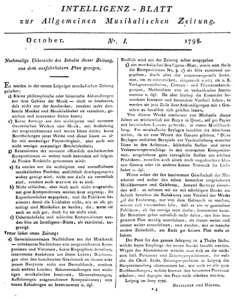
A quantitative study of the 779 composers and arrangers whose works are advertised in its pages reveals the frequency with which Breitkopf & Härtel entered into new professional relationships and the strength with which those relationships endured, as measured not only by their typical length but also by the average rate at which the publisher brought a composer’s work to press. Despite the firm’s best efforts, most relationships lasted for less than one year. Together, these observations illustrate in demographic terms both the challenges and the opportunities by which a composer could pursue economic success in the nineteenth-century musical marketplace.
As noted in the acknowledgements, I remain indebted to Allan Keiler, Margarita Corral, and Eric Chafe, all at Brandeis University, as well as to Marianna Ritchey at the University of Massachusetts Amherst, for providing valuable feedback on earlier versions of this article. I also presented portions of the article in talks at the New England Chapter of the American Musicological Society and my home institution, the University at Buffalo.
Prices of Music at Breitkopf & Härtel
Strykowski, Derek R. “Prices of Music at Breitkopf & Härtel: Publication Lists from the Intelligenz-blatt zur Allgemeine musikalische Zeitung.” Data set with introduction (2018). https://dstrykowski.shinyapps.io/pricesofmusic/
Soon after the publication of “The Business of Composition: Measuring Economic Relationships at Breitkopf & Härtel, 1798–1838” (above), I released the broader data set that has made such research possible. Prices of Music at Breitkopf & Härtel: Publication Lists from the Intelligenz-blatt zur Allgemeine musikalische Zeitung now enables other researchers to apply advanced search and filtering capabilities to over four decades of historical data about a key firm in the nineteenth-century music trade. The 6-page introduction is also available to download from the Commons Open Repository Exchange.
Breitkopf & Härtel founded a weekly newspaper called the Allgemeine musikalische Zeitung in October of 1798. About once per month, for the next forty years, readers also received a supplement called the Intelligenz-blatt zur Allgemeine musikalische Zeitung. A central feature of the Intelligenz-blatt, before its discontinuation in December of 1838, were the publication lists in which Breitkopf & Härtel and other firms would advertise their latest music to potential customers. The 159 publication lists issued by Breitkopf & Härtel itself provide a record of the musical editions (and occasional books and portraits) that the publisher printed during the early nineteenth century. This data set contains 6,405 advertisements for the music of approximately nine hundred composers and arrangers. Details gathered from the publication lists include the issue number, date of advertisement, name of composer or arranger, title of publication, key, instrumentation, and price (quoted in Saxon thalers and groschen). Entries are tagged to indicate repeated advertisements.
I gratefully acknowledge the many colleagues and mentors who have lent their support and guidance to the project that has produced (among other things) the above data set, including Allan Keiler, David Huron, Margarita Corral, Stephanie Vander Wel, and James Currie, as well as the staff of the Lewis Music Library at the Massachusetts Institute of Technology.
 Derek R. Strykowski