Having recently traveled down to Washington, D.C., to conduct some research at the Library of Congress, I found myself reflecting on my (thus far) limited yet always memorable experiences digging through our nation’s libraries and archives. An archive can often be rich in information yet also almost meaningless without a historian (like me—or you!) to figure out what is significant about it. That’s when the “stuff that happened” begins to turn into history, and that’s also why people tend to argue about history even when they agree with each other about the basic facts.
I had somehow managed to write an entire doctoral dissertation in music history without having needed to do any firsthand archival research. But as I later began to focus more and more on American music publisher Arthur P. Schmidt, I realized that I needed to see some important primary sources for myself.
Last year, my investigation of Schmidt’s first years in the United States led me to the Boston Public Library, where I had the opportunity to examine several issues of a German-language newspaper that Schmidt helped to publish in Boston during the 1860s. I also got a chance to consult a 1915 edition of the Boston Directory for my current digital project, Musical Geographies of Boston. Perhaps the best part of the trip was the lunch that my wife and I shared afterwards, on a leafy patio just across Copley Square. She also snapped a photo of the professor at work (below) while coming to meet me!

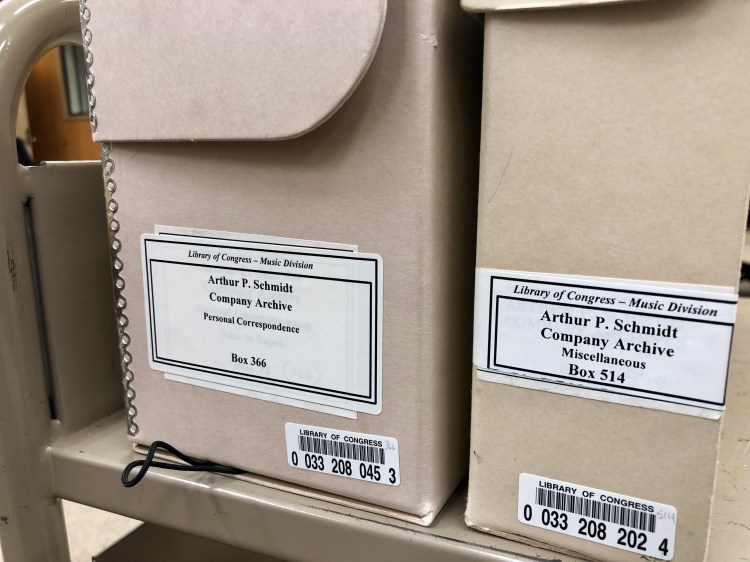
This year, I flew down to the Library of Congress to pay my first visit to the official A. P. Schmidt Company Archives, housed in the library’s James Madison Memorial Building (below, with random scholar). I was seeking to learn more about Schmidt’s involvement with a short-lived musical magazine called the Musical World (1901–1904), and the collection did not disappoint. My first encounter with these invaluable materials was, on the whole, an encouraging success. While the Schmidt collection is probably, by LOC standards, a small one, I feel that I barely scratched the surface of what it has to offer.

How appropriate that Schmidt, who took such genuine pride in the music of his adopted homeland, should have his business records—and publications!—housed and preserved just steps from the nation’s capitol.
 Derek R. Strykowski